

“I play the notes as they are written, but it is God who makes the music.” — Johann Sebastian Bach
In this fallen world cursed with thorns and thistles, God also gave us undeserved blessings: beauty in nature and the creative ability to express beauty in art. The appreciation of beauty is innate to human experience. And while all art forms reflect that blessing, music is distinct—its harmonic structure is embedded in our very being, resonating through our heart, soul and mind.
Specifically, our hearts beat in 4/4 rhythm, and setting words to music encodes information and meaning in our minds. And beyond being just a mnemonic device — MI‑SS‑I‑SS‑I‑PP‑I —musical expression reaches deeper, touching our emotions and our very soul.
Music of the Spheres
The universe itself operates under harmonic, rhythmic patterns. Ancient Greek philosophers taught that the movements of the Sun, Moon and planets follow mathematical ratios that mirror musical intervals, and Renaissance scholars adapted that idea into the “music of the spheres.” Johannes Kepler, a key figure in the 17th-century scientific revolution, believed planetary motions produce an intelligible, soul-perceived harmony—a “universal music” of harmony, if not perceivable sound.
Modern scientists may scoff at the music-of-the-spheres philosophy, yet they acknowledge that orbital mechanics, wave functions, quantum physics, and string theory follow mathematical patterns that reflect celestial harmony. A new frontier of data science—sonification—converts observed data from telescopes and spacecraft into sound patterns mapped to musical notes, tones and rhythms. Here’s a sample.
One may dismiss the music of the spheres as an outmoded Renaissance philosophy or call its recent expression in sonification science fiction, yet through it God reveals truths about His created universe and hints at the glories of heaven believers will come to know.
Music Is Foundational To Worship
From Exodus 15 where Moses sang, “The Lord is my strength and my song, and he has become my salvation,” and the Song of Moses recorded in Deuteronomy 32, “Give ear, O heavens, and I will speak, and let the earth hear the words of my mouth,” through the songs recorded in Psalms and those in Revelation, songs and music are foundational to how God communicates with us, and how we communicate with Him.
That is why congregational singing has been central to Christian worship for the last 2,000 years. As Jesus said, “I will tell of your name to my brothers; in the midst of the congregation, I will sing your praise.” (Hebrews 2:12)
Against the backdrop of cosmic harmony and beauty, I question whether modern worship is drifting from the “Faith of Our Fathers” to something almost antithetical in the move toward rock ‘n’ roll driven praise songs. Too often it feels less like reverential worship and more like worldly spectacle and performance.
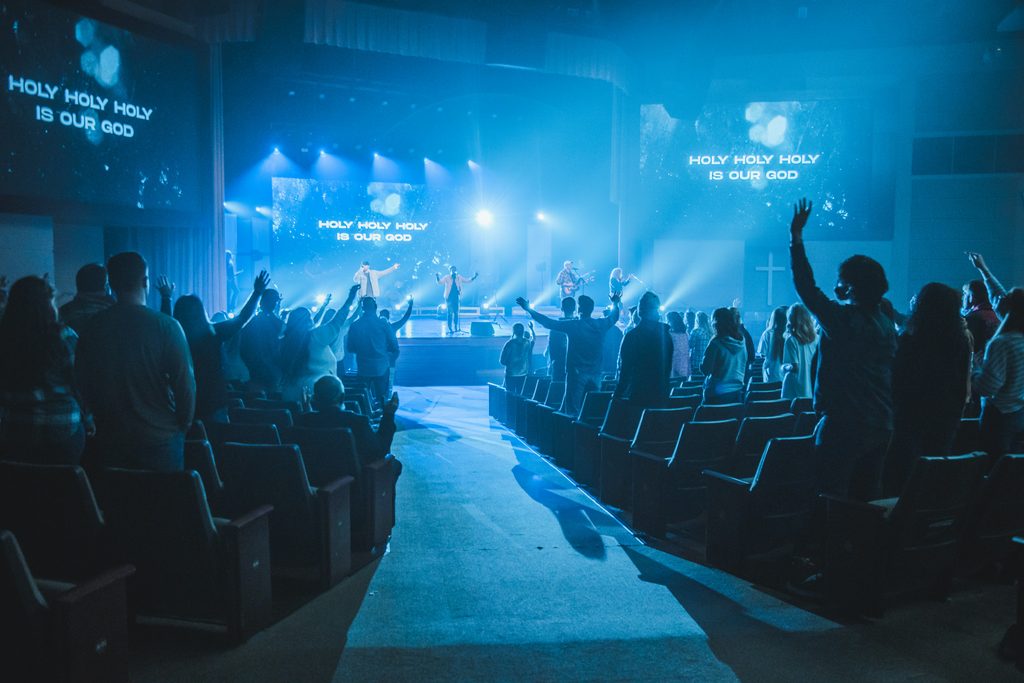
Church pews are filled with time-tested, theologically sound, denomination-approved hymnals complete with musical notation so the congregation can follow the score—try singing a modern praise-song bridge without written notes to guide you. Yet those hymnals remain unopened, replaced by screens that dominate the sanctuary with lyrics alone. And where, in all that praise, is the Bible-based teaching meant to shape our faith?
Chris Tomlin’s “Holy Forever” is one of the most popular congregational praise songs today. It’s a lovely melody—easy to sing, simple in message, but undeniably repetitive:
And the angels cry holy
All creation cries holy
You are lifted high, holy
Holy forever
Hear Your people sing holy
To the King of kings, holy
You will always be holy
Holy forever
Tomlin sings of “All who’ve gone before us and all who will believe” join in the “song of ages to the Lamb.” Yes—and all who’ve gone before us sang the song of ages contained in our hymnals. Where is the biblical substance that lodges in our memory and seals itself in our hearts?
As nice a song as “Holy Forever” is, it tells us things we already know, not the deeper biblical truths we need to carry forward in our faith—“I have stored up your word in my heart so that I might not sin against you.” (Psalm 119:11)
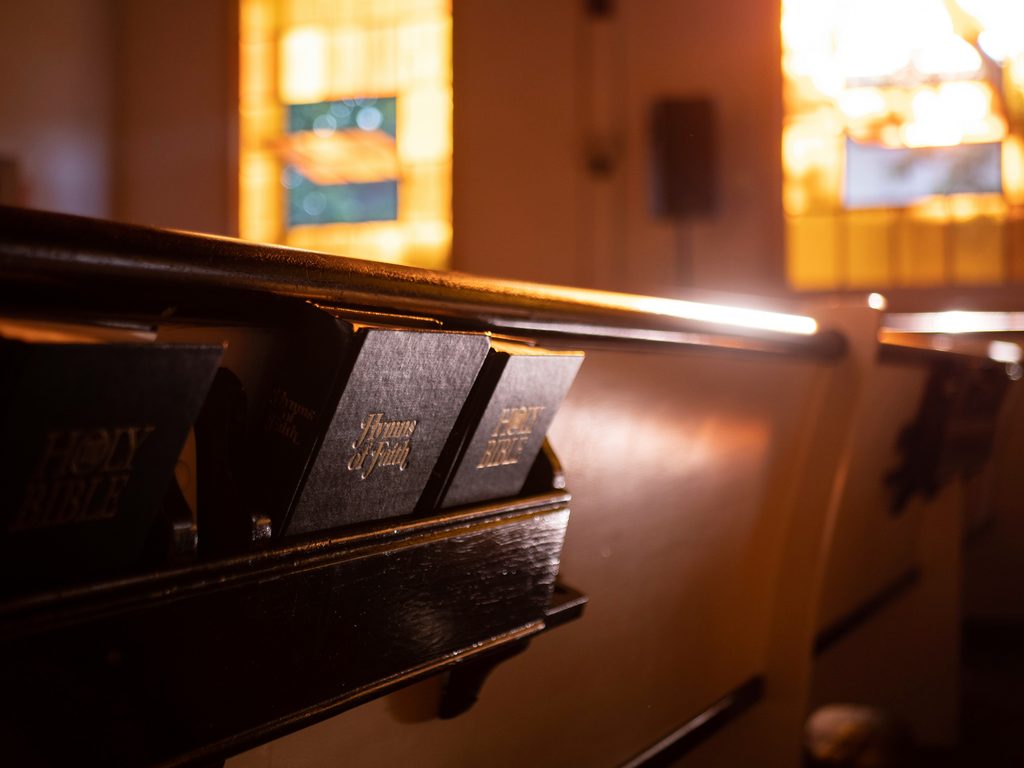
I could point to countless hymns of the faith as examples, but Martin Luther’s “A Mighty Fortress Is Our God” stands apart:
A mighty fortress is our God,
a bulwark never failing;
our helper he, amid the flood
of mortal ills prevailing.
It has worship, praise and biblical teaching wrapped in one unified musical message. Our four-year-old son Ariel could sing all four verses of that hymn—and he did on the night our minister came to pick him up to babysit when his little brother Nathanael was born. Pastor George Morton was amazed.
Give Me That Old Time Religion
I’ll admit: I hanker after that “Old Time Religion” I grew up on. And whenever I can, I share my preference for classic hymns with worship leaders. Fortunately, our church’s talented worship team hasn’t let the excesses of many others slip in, but I still ask, “How about including just one traditional hymn in next Sunday’s worship set?” and give them a thumbs-up when they do.
Ultimately, I’ve made peace with the praise-worship shift that has overtaken modern congregational singing. As imperfect as I consider many contemporary praise songs, God is still using them to draw people to Himself. For that, I must eternally give Him praise—even as I long for more substance in the music we sing each Sunday.
And so I follow the example of the praise song in Revelation 19:
Praise our God,
all you his servants,
you who fear him,
Small and great.
Hallelujah! For the Lord our God the Almighty reigns.
Pam, Thank you for the Refreshing perspective on church music. It is long overdue.
Would you be interested in going to a Psalm Sing some Sunday Evening with us?
A-cappella (in chapel) w/ 4 part hormone or try a chant or two?
– Almost 50 years ago, I volunteered with and under a wise assistant director, George Kell at Greater Harrisburg Youth For Christ who said “church music is about 20 years behind secular music.”
– As I pondered that statement, I began to see that pattern repeating over the years.
Not only are the words simplistic but the “music structure” it’s self is very simplistic. Chords and same notes with no 4 part harmony occur over and over again. Could this be another trick from the evil one to dilute the complexity of God’s creation to simple evil dilutions? Lulling us to sleep? And not even realizing it.
– Wake up Your Church Universal, LORD. Wake me (us) up LORD. For Your Names Sake, May It Be, because You are the Great I AM.
Well spoken Pam!